First day cover ·
Londolozi Wildlife Photography: Eagles, Lions and a Rising Summer Bush
A week at Londolozi moves from river action to leopard, lion and cheetah portraits, with wide-angle framing and silhouette light shaping the photographs.
At Londolozi, the shift into summer is changing both the pace of the bush and the pictures it offers. Cooler mornings and evenings still provide the best windows for activity, while warmer days bring animals into shade and reward patient observation. This week’s photographs range from the force of hippos in shrinking pools to a chameleon crossing at road level, with several encounters shaped by waiting for the right light or a small change in posture.
Water, movement and morning light
Near camp, tracker Advice watched hippos returning to a waterhole after a night of feeding. An African Fish Eagle then swept in, caught a sizable catfish and carried it to the branches of a dead leadwood tree. The sequence puts the fish eagle’s hunting moment in context: the hippos were already moving back into the water as the day began, and the eagle made its own use of the same waterhole.

Tracker Advice spotted the eagle after it seized a catfish at the waterhole and settled in a dead leadwood tree with its catch.
Hippos have been a recurring subject as winter’s waterholes and river channels dried. Competition for the deeper pools has made displays more frequent, including this burst of thrashing water. The movement supplies the frame with energy, but it also speaks to how concentrated water can bring animals into closer contact.

As water sources contracted, encounters around the deeper pools became more animated.
At a causeway crossing, a large crocodile lay on sand deposits in the central channel of the Sand River. In the morning light, it was regulating its body temperature. The stillness makes a useful counterpoint to the hippo image: the river’s activity can be dramatic, but patient observation also reveals quieter behavior.

A crocodile rested on sand deposits in the Sand River’s central channel, warmed by the morning light.
Big cats: waiting for a change
A sighting of the Maxim’s Male began in a dense drainage line. The vehicle approached slowly to keep the leopard relaxed, then settled on the bank where a gap opened among the trees. After some time, the male climbed onto a fallen weeping boer-bean tree directly in front of the vehicle. The moment depended on giving the animal space and waiting for the surrounding vegetation to reveal a clear view.

After a patient approach into the drainage line, the Maxim’s Male climbed a fallen tree in front of the vehicle.
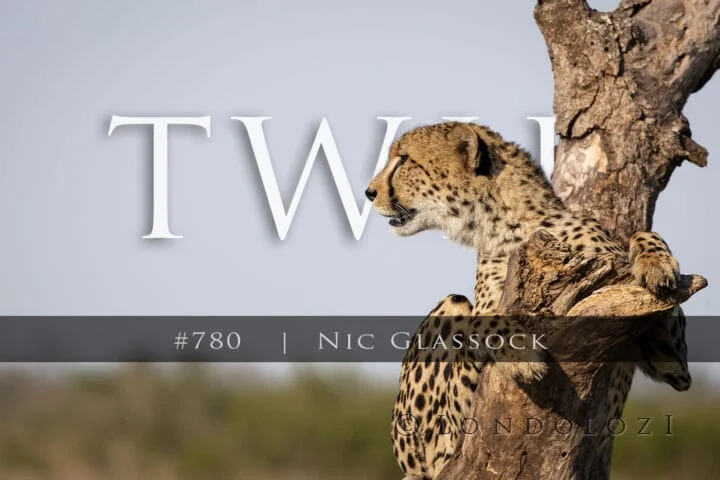
The Makhatini Male cheetah brothers spent much of a warm afternoon resting beneath a spikethorn. As temperatures eased, one brother climbed onto a fallen marula tree to survey his surroundings before moving on. That pause offers a compact portrait of the changing conditions: shade through the heat, then renewed movement as the day cools.

One of the Makhatini brothers climbed a fallen marula as the afternoon cooled.
Roaring across the Sand River prompted a search on the opposite bank from camp. The source of the calls was the Nkuhuma Breakaway Male, found resting on the side of a termite mound after a noisy morning. Elsewhere, the Hlambela Male was resting beneath a jackalberry tree near a warthog kill he had hoisted into its branches. Flies kept bothering him; a brief pause in his attempts to catch them gave the photographer a close view of his eyes.

After a morning of roaring, the Nkuhuma Breakaway Male rested beside a termite mound.

The Hlambela Male briefly looked up from beneath the tree where he had hoisted a warthog kill.
Small encounters and changing compositions
One of the morning’s last sightings came from tracker Advice: a flap-necked chameleon crossing the road. The photographer got down from the vehicle and lay low to watch it move, swaying like a leaf as it crossed. That eye-level view turns an ordinary road crossing into a study of movement and concealment, while keeping the chameleon’s safe passage at the center of the encounter.

A low viewpoint revealed the chameleon’s swaying gait as it crossed the road.
The youngest Kambula Pride cubs are also growing into more independent behavior. After feeding on a nyala bull in the Tugwaan drainage, one cub climbed the bank and stretched its claws against a tamboti tree beside the vehicle. The picture catches a brief, everyday action that makes the cub’s development visible without needing a chase or dramatic interaction.

After feeding, a young Kambula cub stretched and sharpened its claws on a tamboti tree.
Seasonal change also invites a wider frame. As the first rains arrive, the bush is gaining its spring and summer color. A black-and-white photograph places a giraffe among marula trees beginning to regain their leaves, using the landscape around the animal as an equal part of the composition. Wider views can give viewers a stronger sense of habitat and scale than a tight portrait alone.

A wide black-and-white frame pairs a giraffe with marula trees putting on new leaves.
Light at the edges of the day
Several lion sightings show how changing light and animal behavior shape a frame. A breeding herd of elephants moved past three N’waswitshaka Male Lions in the afternoon. The elephants kept going, leaving the lions to watch as the herd disappeared into golden sunset light. Near a tamboti tree, the Shingi Male looked upward at his mother, the Nkoveni Female, who was feeding on an impala carcass in the canopy. In another late-afternoon scene, a young hyena cub rested just outside its clan’s den entrance. At this age, growing curiosity and a stronger sense of smell encourage it to explore farther from the tunnel.

Elephants moved past the three N’waswitshaka males in golden afternoon light.

Shingi watched his mother, Nkoveni, feed on an impala carcass in the tree.

A young hyena cub rested beside the entrance tunnel to its clan’s den.
A Verreaux’s Eagle Owl was found after a squirrel’s alarm call drew attention to the area. No ground threat appeared, so the search moved into the canopy, where the owl sat framed above the group. The final photograph uses the opposite approach: a kudu bull becomes a silhouette in early or late light. At those hours, shape and tone can carry the scene, giving the image a strong sense of place without relying on fine detail. This week’s pictures make a practical case for staying alert to both the subject and the light around it: the defining moment may be a sudden catch, a slow climb, or simply the instant an animal turns its gaze.

A squirrel’s alarm call led the search from the ground into the canopy, where a Verreaux’s Eagle Owl sat above.

Early or late light turns a kudu bull into a study of shape, with silhouette conveying the mood of the scene.


