First day cover ·
Kambula Lionesses Return to Familiar Ground at Londolozi
Two northern Londolozi lionesses turned up in the southeast with four surviving cubs, a reminder that lion movements rarely follow a plan.
A sighting that wasn't on the list
The morning began with a loose plan: drive into the southeastern corner of Londolozi and see what the reserve offered. Lions were the goal, but the pair that appeared around a corner about 45 minutes in was not what anyone expected. At first glance they looked like members of the Southern Kambula group, whose cubs had been the talk of the reserve. The hope was that this was them. It wasn't.

A Kambula lioness resting in the clearing. Running into two of the group this unexpectedly was a pleasant surprise.
On closer approach, the two were the northern lionesses, sisters to the Kambula females. Both had raised litters born earlier last year: one with four cubs, the other with two. Finding them in the southeast was the real story.
Why their appearance mattered
These lionesses had spent a long stretch far north, even beyond the reserve's northern boundary. There had been no recent record of them drifting south through Londolozi. Seeing them suddenly back in an area they knew well, with no obvious trail leading there, made the encounter feel almost improbable. Lion movements often work this way: a pride can vanish from the records for weeks, then reappear in a spot nobody was watching.

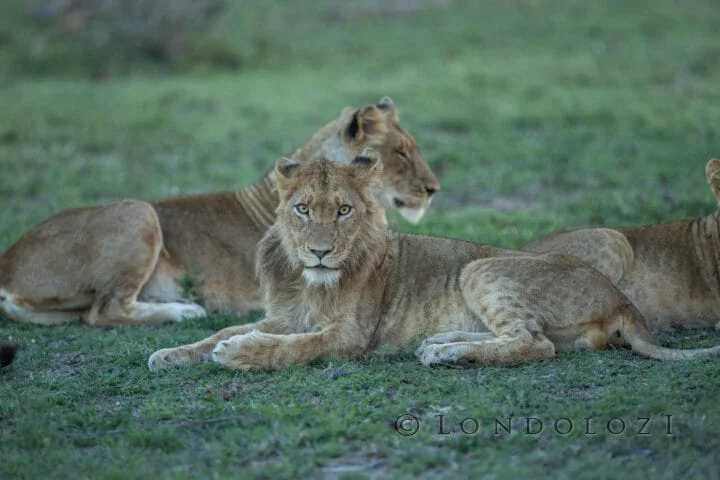
One of the young male cubs rests with two of the young female cubs in the background. The cubs looked healthy, well fed and free of injury, which made seeing them again a real privilege.
Counting the cubs
Six cubs were born into the two litters, which made the number on this drive hard to ignore. A few months earlier, the news came through that one of the youngsters had been killed by the Plains Camp Males, leaving five. Seeing only four this time raised immediate questions.

A look back at all six cubs together. This was taken shortly after the group rushed into the northern parts of Londolozi, searching for fathers who had been chased out of their territory.
A guide working further north helped piece the likely sequence together. It appears a second cub was also killed by lions, leaving four: seemingly two males and two females. That's a hard loss for a pair of mothers, but the four that remain are about 20 months old. They've moved past the most vulnerable stage, and the two lionesses kept them alive through a stretch of serious pressure. That's the part I keep coming back to.
Pressure from the north
The cubs' fathers, the two Ndzhenga Males, have been facing growing challenges further north. Pressure of that kind can push females to reconsider where they feel safe. It's possible that's what pulled these lionesses back toward ground they know.

Another look at the second young male. It's good to see him so healthy despite losing two littermates.
Back on home ground
These lionesses were born and raised on Londolozi. They know the waterholes, the cover and the routes that have worked for them before. Bringing growing cubs back into familiar territory may have been a way of finding security while things got tougher elsewhere. Here's the thing, though: they didn't stay long. Shortly after the sighting, they slipped out of view again. They could be wandering the reserve or heading north toward the Ndzhenga Males. Nobody can say for sure, and that uncertainty is part of what makes wildlife viewing worth the early starts.

One of the young females gazes at a herd of impala in the distance while the rest of the cubs settle in to sleep through the heat of the day.
What this teaches about shooting wildlife
For photographers, a sighting like this is a lesson in patience and readiness. Cubs at this age move quickly and sleep in unpredictable spots, so it helps to stay on a long lens with enough reach to frame a cub without disturbing it, and to keep a shutter speed fast enough to freeze sudden head turns. Shooting into shade or soft morning light also tends to bring out fur detail better than harsh midday sun, which in turn makes the difference between a record shot and a portrait. None of this guarantees the moment, but a camera ready to go is what lets you capture it when it comes.
Whatever drove the move, it was a reminder that lion movements are rarely predictable. After months far from where they were born, the Kambula lionesses and their four remaining cubs had quietly come home, and for one morning, the team got to be there to see it.