First day cover ·
Hlambela Holds His Warthog as Tsalala Tests the Branches
A Londolozi leopard keeps a warthog kill out of a lioness's reach in a weeping wattle, and the standoff shows how far a cat will go to protect a meal.
Some afternoon drives come down to one easy call. In September, a report of a leopard with a kill in a tree settled it for us at Londolozi. The leopard was the Hlambela Male, an occasional visitor whose calm temperament, patient hunting and fondness for warthogs have made him one of my favourite animals to follow. A second warthog kill was reported that day, and I wanted my guests to see more of him.

The Hlambela Male waiting patiently on a termite mound for a warthog to surface.
A Male Who Is Making His Mark
Hlambela, also recorded as Hlambela 2:2, is an eight-year-old male first seen in 2018. Londolozi's profile describes him as a rising force in the north, a male who has been building his reputation by pushing other males out of their range. That context matters when you watch him. A male holding ground in a contested area has every reason to protect a carcass, and his choices that afternoon fit that pattern.
We took our time getting there, stopping on open crests and at the Ximpalapala koppie along the way. At the last location we spotted the hoisted warthog first, the leopard's signature meal, and then found the male resting in the grass nearby. He got up and walked straight towards the vehicle. His resting spot turned out to be directly behind our rear tyre. One guest moved across to the far side of the vehicle, but she was brave enough to lean over the railing and photograph his spots. Close encounters like this are where good guest briefings pay off. Calm voices, no sudden movements and a clear sense of where the animal can go all make a difference.

The Hlambela Male showing off his relaxed attitude
Waiting for the Leopard to Move
With the male lying beneath us, moving the vehicle was no longer an option. For a few moments I wasn't sure what the next step would be. Then he made it for us. He broke from beside the vehicle, raced up the tree toward his kill, and a hyena emerged from the bushes below. Once we could reposition, we found a clear view of him feeding high enough to stay out of the hyena's reach. The crunch of bone carried down through the branches as he worked the carcass.

The Hlambela Male in his natural element.
The Lioness Arrives
We were all fixed on the leopard above us when tracker Trevor called from behind the vehicle: "Lion! Lion! Lion! Tsalala! Tsalala!"
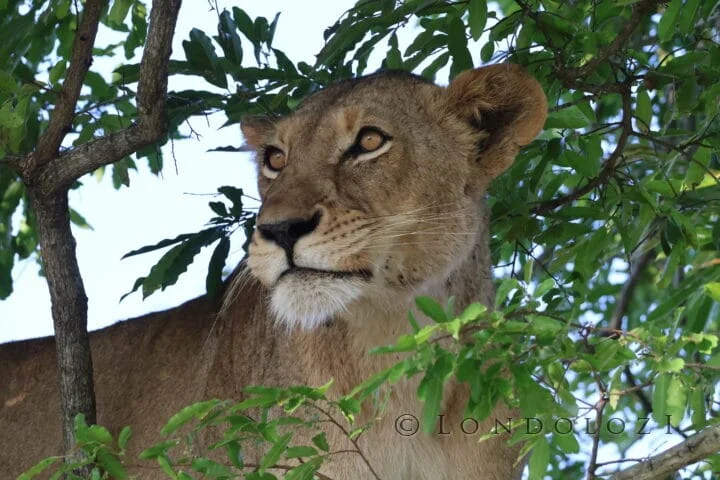
I turned around. Less than ten metres away was the famous Tsalala Lioness, looking past the vehicle and straight up into the tree.

She circled the base of the tree slowly, scanning the branches. Lions don't climb as readily as leopards, and a female living on her own has to be resourceful. Tsalala has adapted her hunting and movements in ways that sometimes look almost leopard-like, so a meal hanging in a tree was clearly worth investigating. I kept asking myself the same questions. Would she try? Could she manage the climb? And if she did, what would Hlambela do?
She picked her route and started up, awkwardly. Above her, Hlambela let out a deep growl that carried through the canopy. He gripped the carcass and dragged it higher into the smaller branches of the weeping wattle. We watched in near silence as she worked her way up, and for a moment it looked like we might see a physical confrontation in the tree.
Where the Branches Decide
Then she stopped. Hlambela had moved onto a different fork where the branches were thinner, and Tsalala stayed on the sturdier limb below, looking up at him and the warthog. Following him would have meant trusting much finer wood with a considerably heavier body, and that is the real limit a lion faces in a tree like this. She could push on and risk the branches, or she could stop. I quietly pointed this out to the guests. We waited while she appeared to weigh her options.
Eventually she began coming back down. Once on the ground, she walked off toward the river and left Hlambela in the canopy. The warthog was now his to keep. We stayed with him a few more minutes, long enough for our heart rates to settle, before heading back for a cold drink and a conversation about an afternoon we'll be retelling for years.
What to Take From It
For anyone trying to photograph sequences like this, the lesson is about timing and patience. Leopards that hang kills in trees often stay near them for a day or more, but a competing predator can appear in minutes, so the first thing to do on arrival is read the body language of everyone in the scene. Keep the lens ready for the descent and the reaction on the ground, not only the feeding shots. And keep your position steady when a leopard approaches the vehicle. The most useful frames that afternoon came from people who stayed composed.
Hlambela's territorial push in the north will shape where he is seen next. I'll be watching for him on the crests and along the koppies, and I'll be watching Tsalala's movements too, to see whether she tries the tree again.