First day cover ·
Wide Frames and Wild Dogs: A Week of Londolozi Wildlife Pictures
A 70–200mm walk through leopards, wild dog pups, cheetahs and elephants, with wider frames that show the bush around the animals.
Switching to a 70–200mm f/4 on the EOS R6 Mark II this week changed how I was looking at the bush. The last few weeks leaned on the 300mm f/2.8 and the 200–400mm f/4 with its built-in 1.4x teleconverter, and those lenses pull subjects tight. This time the goal was to keep more of the surroundings in the frame, so the animals sit inside their habitat rather than filling the picture. A portrait or two still made the cut, but the approach was different.
The lens question is less about which glass is best and more about what you want the picture to say. Some photographers want every whisker and feather filling the frame. Others want the grass, the trees and the light to carry as much of the story as the animal does. If you're planning a safari and trying to decide what to pack, start with the images you already enjoy and the ones you'd like to bring home. That answer usually points to a lens. It might also push you to try a focal length you'd normally skip on your next drive.
Keeping the landscape in the frame

A rare symmetrical composition of the Mhangeni Pride. The black-and-white treatment pulls the separate elements of the scene together into one image.
Black and white does a lot of the heavy lifting in that Mhangeni Pride frame. Once colour is removed, the eye reads shape and tone first, and the symmetry becomes the subject. It's a useful reminder that a wider lens isn't only about showing more background. It's also about letting the composition do the work the telephoto usually does.
Leopards on their own ground

Scent marking is a message our noses barely register. Leopards mark evergreen trees because the scent lingers for long periods. Here it's the Hlambela Male on his territorial patrol.
The Hlambela 2:2 male, about eight years old and tracked since 2018, is a leopard to watch. He's described as a rising force in the north, making a name for himself by pushing other males out. Scent marking shows that patrol work in action, and a tree-level frame like this one benefits from the surrounding habitat being visible.

The Hlambela Male waiting patiently on a termite mound for a warthog to surface.
Patience is most of the work in that termite mound frame. Setting up on high ground lets the background stay readable without losing the leopard. Wider framing is forgiving here, because the mound and surrounding grass give the eye a reason to stay on the scene.

Tinxiya Female starting to get more active as dawn rolls in. She then continued her territorial patrol.
Tinxiya 4:3, a female around two years old, is nearing independence after an unusually strong start alongside her mother. That's a leopard whose life is opening up, and a frame that shows the terrain she's moving through tells that story better than a tight crop would.

The distinct face of the Maxim's Male.
Close work still has its place. Maxim's 5:3, around 13 years old and dominant since 2019, was once a skittish Kruger-born leopard who has grown into a presence across a large territory. A tight portrait captures that intensity in a way a wider frame can't.

There is something special about seeing different species sharing the same space, each going about their day in their own way. A herd of giraffes and a couple of zebras beneath these large trees made for a simple but beautiful scene in the bush.

An incredible contrast with a large rock fig on a boulder behind the Xinzele Female.
Xinzele 4:4, a nine-year-old female found in the north, has successfully raised the Thumbela Female while establishing herself in NW Marthly. The rock fig behind her gives this frame a strong backdrop, which is exactly what a wider lens is good for: the setting becomes part of the composition, not just a blur.
Wild dogs in the den and the dust

The sand river never disappoints. A bull elephant drinking along the sandy banks of the sand river.
Wild dog pups need patience. The young ones in this set were slowly habituating to our presence, and the closer shots came from staying put and letting them settle. A shot of pups lined up as the adults returned to the den shows the pack structure clearly, and it's the kind of frame where the den site itself adds meaning.

Young wild dog pups slowly habituating to our presence.

Young wild dog pups mid-play fight.

These young wild dogs pups were lined up watching the adults of the pack on approach back to the den site.

A rather over-exposed photo of a moving wild dog at sunset which allowed for a clear view of the surrounding landscape.
That sunset frame is a good example of trading some exposure precision for landscape. The highlights run hot, but the dog's silhouette and the open ground around it read clearly. Pushing slightly over can work when the environment is part of the story.
Cheetahs, elephants and the sand river

This image was captured as the chase of this male cheetah started. The animal was in pursuit of a young waterbuck.
Action from a wider position needs room to breathe. The termite mound in this cheetah frame tells you where the animal is in the landscape, and the pursuit feels more immediate because the ground around it is visible.

A one-tusked young elephant bull striding down the road in his early stages of musth.
The one-tusked young bull walking the road shows how a roadside frame can carry context. Musth shows in his bearing, and the open track gives the picture its sense of movement.
Birds and the wider bush

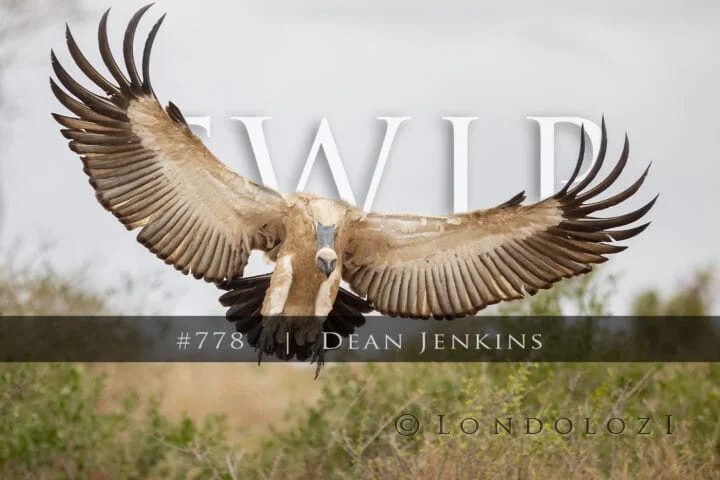
One of the rarer vultures we see at Londolozi. The Cape Vulture descending on a carcass.

Hooded vultures circling a wildebeest kill from the Ntsevu pride.

A White-backed vulture preparing for landing.

Morning light catches a Saddle-billed Stork mid-flight.
Birds reward the wide-angle habit more than almost anything. Vultures working a carcass or a stork crossing morning light are stronger in a frame that includes sky and terrain. Black-and-white conversion suits the vulture shots, because the silhouettes and wingspan carry the image.

The Thamba Male awaits patiently at a warthog burrow; however, he is able to remain in this position for hours due to the shade provided by a buffalo thorn tree.

This was a tricky photo as I had to try to avoid all branches to get a photo of the Tinxiya female in golden light. Definitely one of my recent favourites.
The thorn-tree shade behind the Thamba Male explains why he can hold a warthog burrow for hours, and that's the kind of detail a wider frame keeps. The golden-light Tinxiya shot is the opposite challenge: threading a lens through branches to find a clean opening. My read is that the more of the bush you include, the more you have to work for a clear line, and that trade is usually worth it.
If you're deciding what to try on your next drive, pick one scene and shoot it twice, once tight and once wide. Comparing those two frames will tell you more about your own style than any lens review.