First day cover ·
Gijima Lions Feed on a Nyala After a Hidden Chase
A morning of tracking the Gijima males and Ntsevu females turned into a close view of a nyala kill, though the chase happened out of sight.
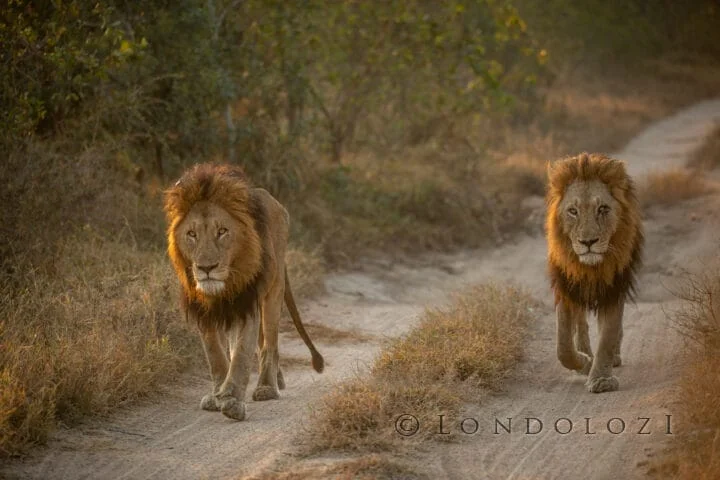
The most revealing part of this lion sighting happened out of view. A nyala was flushed from a drainage line, the chase slipped beyond the vehicles’ sight, and the first clear sign of the outcome came when two Gijima males suddenly became animated. By the time the group found the lions again, a female nyala was dead and the males were feeding.
The encounter unfolded on the morning of 18 October. The plan was to find the Gijima males and Ntsevu females, beginning with tracks near the reserve’s eastern boundary. The trail led toward its centre, where Nic Martin had located the lions 20 to 30 minutes before the rest of the group arrived.
Two males and five females were resting near a prominent drainage line. The morning was warming, and the lions had settled in the shade after walking a considerable distance. With no obvious sign of activity, the expectation was to watch for a while and then leave them undisturbed.

A sudden movement at the drainage
That quiet plan changed when one of the females rose and walked toward the drainage. At first, her movement looked like a search for shade. The other females followed in turn, and the two males eventually got up and came behind them. Then a female nyala burst from the drainage line.

One lioness pursued the nyala, but she was some distance behind, and the animal initially ran away from the other lions. The chase looked unlikely to succeed. The nyala kept running, however, then looped back toward the drainage and the lions waiting there.
At that point, only the two males were visible. They had not yet descended into the drainage, but their sudden excitement suggested that something had happened below. The group tried to find a view from different angles and saw nothing. From another position, Nic Martin also had no clear view. Several females were lying on the bank, grooming and appearing relaxed, so it seemed possible the chase had come to nothing.

A young Ntsevu female poised perfectly for a shot. These two young females have really been leading the charge from a hunting perspective of late. The lineage of this incredible pride is in very capable hands/paws!
The kill remained out of sight
The outcome became clear only after the group returned to its original position and drove a little farther down. There, two males and two females were gathered around the dead nyala. No one had seen the final moments of the chase, so the account of how the kill happened remains an informed guess rather than a direct observation.
The females may have made the kill. They were the first lions to enter the drainage, and the one seen chasing the nyala was a female. The males were still on the bank when the pursuit began, while the nyala ran back toward the place where the females had gone. Those details point to the lionesses playing the leading role, though the hidden terrain kept the decisive moment from view.
The group drove down into the drainage line and came to a stop about five metres from the lions, briefly concerned that the vehicle might get stuck. The males had pulled the nyala behind a fallen tree, obscuring much of the scene. The females moved around the vehicle at a distance, while the males fed.
The males feed first
Then the males dragged the carcass from behind the tree and brought it close to the vehicle. At one point it lay about a metre and a half away. When males are with females at a kill, they commonly take control and feed first; that appeared to be the pattern here. A female nyala is relatively small, and two males consumed much of it quickly. With larger prey, there might have been more left for the females to eat properly.
The competition over the best portions was physical and noisy. The two males wrestled and growled as they contested the carcass, while a couple of females tried to get close enough for a share. Some managed a few bites, but the males kept most of the food. At close range, the combination of lions around the vehicle, the sounds of feeding and the smell of a fresh kill made the encounter especially intense.
The group watched for 30 to 40 minutes, then left the lions in the drainage. The pride was later found on the crest, where it may have moved after finishing its meal and resting. The sighting began with tracks and an expectation of little activity; its defining moment happened beyond view. What the group could see clearly was the aftermath: the males feeding, the females waiting for an opening, and the close, unsettled rhythm of a pride gathered around a kill.


