First day cover ·
Xikutsu Female Leopard Begins Marking Her Own Territory at Londolozi
Named for the shepherd’s tree near the Manyelethi River, the young leopard is scent marking as she starts establishing a range of her own.
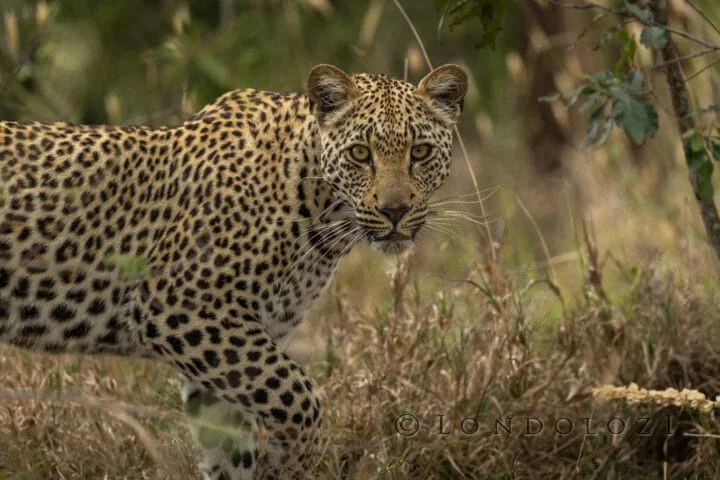
The Xikutsu Female is beginning to leave signs of a territory of her own along Londolozi’s rivers. Recently, she has been seen scent marking and showing more territorial behaviour, a shift that makes the naming of the young leopard feel especially timely: she’s no longer just the Ngungwe Female’s daughter, but an independent animal starting to shape her own patch of ground.


The Ngungwe Female’s young daughter has been named the Xikutsu Female.
Her name, Xikutsu, is a Shangaan word for “shepherd’s tree.” It points to a landmark in the northern part of the reserve, where she spent much of her early life. The area around the Manyelethi River is marked by large boulders and one particularly prominent shepherd’s tree, one of only a handful across Londolozi. She was often found nearby, and a memorable sighting around that tree made it a natural choice for her name.
A name tied to a place can help make an individual leopard’s story easier to follow. In Xikutsu’s case, it recalls the landscape where observers watched her as a youngster, while her recent movements suggest that her relationship with that area is changing. She still spends much of her time near the river, but observations now include behaviour associated with establishing her own presence.

A recent sighting offered a first chance to watch the Xikutsu Female scent mark and show territorial behaviour.
Reading the signs along the river
Since separating from her mother, Xikutsu has remained relatively close to the river. Her movements cover the area opposite camp and stretch east toward Londolozi’s eastern boundary; she also travels north toward the Manyelethi River. Scent marking has become more frequent, alongside other signs of territorial behaviour. These observations point to a gradual process: she appears to be starting to establish herself in this part of the reserve, though the extent of any territory is still taking shape.
For those following a leopard over time, repeated sightings can make changes in space and behaviour easier to notice. A single encounter shows an animal in one moment; a pattern of movement, combined with scent marking, offers a broader indication of how it may be using an area. In Xikutsu’s case, that record is developing as she becomes more independent.

As a younger leopard, Xikutsu found shade on a boulder near the Manyelethi River.
That rocky setting also carries a reminder of how long her story has been observed in this corner of Londolozi. The boulders and river formed part of her early range, and the same broad area is now where she is beginning to show signs of independence. The name connects those stages without implying that her range is fixed: her movements will continue to provide the clearest picture of where she settles.
A daughter’s head start
Female leopards may allow a daughter to occupy part of their territory once she becomes independent. This can give the younger animal a starting area without requiring her to move immediately into entirely unfamiliar ground. It’s a gradual shift in how mother and daughter use space, and it can take time for the pattern to become clear.

The Ngungwe Female watches the last light of sunset from a boulder.
Xikutsu’s movements near camp and along the river have coincided with fewer sightings of the Ngungwe Female in that area. That change raises the possibility that the mother has shifted north, leaving her daughter more room nearby. There are also reports that Ngungwe may have moved farther west, but more sightings are needed to understand where she is spending her time. For now, any account of a shift in her range remains tentative.
The Ngungwe Female’s own history gives that mother-daughter transition added context. Her profile records that she was born in 2020 to the Piccadilly Female and later became a mother herself. Observers have watched her daughter grow from a young leopard in the Manyelethi area into an animal now showing signs of territorial behaviour. If the two females are using different parts of the reserve more often, further sightings will help reveal how that change unfolds.

The young leopard shows her feisty side as she reminds her mother that it is still her turn to feed on a nearby kill.
Xikutsu is the only surviving cub from the Ngungwe Female’s first litter. She began life as one of two cubs; her sibling died before reaching a year old. Reaching independence is a significant milestone for a young leopard, and raising a cub to that stage is no small achievement for a first-time mother. That history makes Xikutsu’s current progress more than a change in name or range: it marks the continuation of a life that began in a litter with a different outcome.
A name for the next chapter
Her recent scent marking offers a visible clue to what may come next, but the shape of her territory—and the precise relationship between her movements and her mother’s—will take more sightings to understand. For now, Xikutsu remains closely associated with the riverside ground where she grew up, while beginning to make her own presence known there.
She has moved from following her mother’s footsteps to leaving signs of her own. Xikutsu, named for the shepherd’s tree near the Manyelethi River, now has a name rooted in the place where her story began and a new chapter unfolding across Londolozi.