First day cover ·
Londolozi Wildlife in Focus: Kambula Cubs, Leopards and Storm Light
Lions dominate Londolozi’s latest wildlife sightings, with Kambula cubs, shifting leopard activity and birds photographed ahead of rain.
Eight Kambula cubs, a leopard watching a waterbuck from a termite mound and storm clouds gathering behind storks: this week’s Londolozi sightings show how quickly the reserve’s scenes can shift. A spell of heat above 44°C was followed a few days later by welcome rain. Conditions remain drier than usual for this time of year, in line with the expected El Niño pattern, but wildlife viewing has stayed varied.
The photographs range from predator encounters to the smaller details that can be easy to miss between sightings. Lions were especially prominent, while wild dogs remained frequent, leopard movements drew attention and a cheetah sighting offered a glimpse of a family now split apart.
Lion cubs and changing family ties
The Kambula Pride supplied one of the week’s most engaging scenes: two cubs leaning into a playful embrace. The youngsters have been a regular source of lively sightings in recent weeks, and the pride’s visit to a waterhole offered a different kind of family moment.

Two Kambula Pride cubs play together. Their close contact makes this a quiet counterpoint to the larger predator scenes in the week’s photographs.
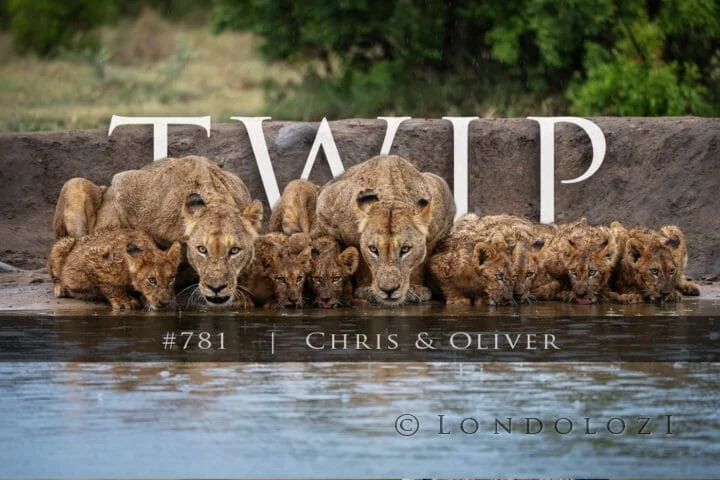
In heavy rain, two Kambula lionesses brought seven cubs to drink after a recent meal. For a time, the litter seemed to have fallen from eight to seven. About 72 hours later, the eighth cub rejoined the pride, apparently unscathed after its time away. That brief separation gives the waterhole scene an added layer: the group is back together, though the reason for the cub’s absence remains unclear.

Two Kambula lionesses lead seven cubs to drink in the rain. The eighth cub rejoined the pride about 72 hours after it was first thought to be missing.
Another lioness, the Nkuhuma Breakaway, makes a more uncertain story. She left her natal pride with her brother more than a year ago. As he has matured and begun ranging in search of other lionesses, she has often been alone. Her loud call captures a moment of presence, but doesn’t answer what comes next: whether she’ll return to her pride or continue a solitary life.

The Nkuhuma Breakaway lioness calls out. She is often alone now that her brother has matured and begun looking for other lionesses.
Leopards on the move
The Makomsava Female is appearing farther back on Londolozi after spending much of her time beyond the area where sightings are usually made. She was photographed first in a tree and then resting on a termite mound, where a nearby waterbuck bull kept watch. The bull was too large for her to catch, but still had reason to be alert to a leopard nearby.

A waterbuck bull holds its ground while keeping an eye on the Makomsava Female, resting on a nearby termite mound.

The Makomsava Female rests on a termite mound and watches the waterbuck bull nearby.
Her renewed presence may signal a shift in the area she uses, though the direction of that change is still uncertain. The Nkoveni Female, meanwhile, appears to be searching for males, and a large, previously unidentified male leopard was seen in the north. Together, these sightings suggest a period of movement and changing relationships, but they don’t yet tell a settled story.

The Makomsava Female has begun appearing more often after a long period largely beyond Londolozi’s usual viewing area.
Wild dogs, eagles and smaller details
Wild dogs have been a dependable presence, with multiple packs roaming the reserve and sightings rarely more than two days apart. A pack of nine approached a river crossing cautiously, a reminder that even a familiar route calls for care when crocodiles may be nearby.

Nine wild dogs approach a river crossing cautiously, alert to the possibility of crocodiles nearby.
Martial Eagles appear in two very different moments: one lifting off, and another with a rock monitor it has caught. Their wingspan can reach 2.5 metres, and sightings of the eagles seem to have increased in recent years. The images show both the scale of the bird and a direct example of its predatory behaviour.

A Martial Eagle takes off, displaying a wingspan that can reach 2.5 metres.

A Martial Eagle with a rock monitor it has caught, a prey animal the species is known to take.
There was room, too, for a young Boomslang spotted by the tracker team in the car park before an afternoon drive. Its large eyes stand out, while its colouring can vary with age and sex. A Broad Scarlet dragonfly brought a vivid flash of colour to a rhino midden; nearby, a crocodile’s profile offered a reminder of a predator shaped by a long history of survival.

A young Boomslang was spotted by the tracker team before the afternoon drive. Its large eyes are a defining feature, while its colouring varies with age and sex.

A Broad Scarlet dragonfly pauses on a rhino midden.

A crocodile seen in profile, its form shaped for life in tropical environments.
Birds under changing skies
Two White-fronted Bee-eaters scan the sky for food. The bird on the right is a juvenile, its paler plumage setting it apart from the other. Later, two Yellow-billed Storks caught the fading afternoon light as dark clouds advanced. Together, these frames connect the week’s wildlife to its changing weather: dry heat gave way to rain, and the skies became part of the scene.

Two White-fronted Bee-eaters watch the sky for their next meal. The juvenile on the right has paler plumage.

Two Yellow-billed Storks in fading afternoon light as dark clouds gather on the horizon.
The Makhatini cheetah family has now split, and sightings have become less frequent after two years of regular viewing. One of the young males was photographed surveying his surroundings from a fallen marula tree. With the leopard movements still unfolding and the Kambula litter reunited, the next set of sightings may bring new developments as the weather changes.

A young male from the Makhatini cheetah family surveys his surroundings from a fallen marula tree.