First day cover ·
OM SYSTEM Cameras in the Field: Small Sensors, Big Results
A month with the OM-1 Mark II shows how Micro Four Thirds handles lenses, stabilization, computational modes and travel weight in real conditions.

OM SYSTEM is the smaller name in a field dominated by Canon and Nikon, and it's built its identity around Micro Four Thirds rather than full frame. The compact Tough TG-7 sits outside that system, but the mirrorless cameras are where the brand's focus lies. The pitch is simple: get strong performance out of a small sensor and a small kit. After a month with the flagship OM-1 Mark II, from waterfall ledges to swampy backcountry trails, that pitch holds up better than I expected.
What the Smaller Sensor Changes

Micro Four Thirds sensors are smaller than even APS-C sensors, and that changes the shooting equation in ways you feel right away. Some of those changes are gains, some take an adjustment period, and some are straight trade-offs.
The 2x crop factor is the most visible one. A lens delivers roughly double its focal length in full-frame terms, which makes long reach far easier to carry. The catch is that this isn't a magnification boost. Think of it as a pre-crop applied in the camera before the image is recorded. Wide-angle lenses still deliver a generous field of view, so the system doesn't lose its wide end.
Depth of field runs roughly twice as deep as full frame at the same f-stop, composition and focal length. That helps when you want more of a scene in focus, such as a waterfall and its banks, but it makes separating a subject from a busy background harder. Noise also becomes visible sooner as ISO climbs, so high-ISO work needs more care with exposure.
The smaller sensor carries an upside too. It draws less power, which leaves room for in-body stabilization for both stills and video, computational features, and the Supersonic Wave Filter ultrasonic dust-reduction system. Sensors in this class typically land between 20 and 25 megapixels, and in-camera high-resolution stacking, which OM shares with several other systems, is one way to recover detail beyond that.
- A telephoto lens of a given length weighs and measures less than its full-frame equivalent.
- Depth of field is deeper, which helps group focus and hurts subject separation.
- Noise appears sooner, so ISO discipline matters more.
The OM-1 Mark II in Real Conditions

The OM-1 Mark II proved to be a workhorse. It made it easier to get the images I wanted, but it isn't a camera you should take out of the box and start shooting with. Set up your custom options first. Once you do, the construction and weather sealing let you stop tiptoeing around the gear, and the ergonomics and lighter weight make a long day in the field noticeably easier on the body.
Stabilization performed strongly. The in-body system worked as promised, and autofocus locked on quickly even with AI subject detection switched off. When AI subject detection was turned on, it behaved as expected, with good hit rates and the occasional miss. That's where every brand still has room to improve.
Three features that earned their place
- Locking lens hoods: The hoods lock into place quickly for storage and use, and a physical release button keeps them from wandering off down a slope. Small detail, big convenience on rocky terrain.
- Automatic sensor cleaning at startup: Physical sensor shields are still a favorite of mine for keeping dust out of the body, but the Supersonic Wave Filter, which vibrates 30,000 times per second, kept the sensor clean throughout the test period.
- Live simulated ND filters, including graduated ND: The built-in options have a few quirks, but they're a real gift for minimalists. They make it easy to protect bright skies or show water motion with a menu adjustment instead of carrying filters.
Two frustrations
- Highlight clipping: Camera systems weight exposure differently, with some favoring shadow detail and others protecting highlights. OM leans toward preserving shadows and will blow highlights if you don't set it up carefully ahead of time. Check your highlight warnings before you trust the histogram's first impression.
- Image numbering: The default setting is "reset," so file numbers restart with each new card or session. That's easy to miss when switching from another brand. Change it to "auto" early to avoid losing track of frames.
Lenses, Portability and Computational Modes

Lenses determine most of the shooting experience, and OM's M.Zuiko digital lenses held up well against the other brands I've tested, including Canon and Nikon. The corners and edges at the extremes of the aperture range didn't show the softness that many Micro Four Thirds lenses are known for. I tested the M.Zuiko Digital ED 8-25mm PRO and the M.Zuiko Digital ED 40-150mm PRO, and both delivered. Images were sharp, focus didn't hunt, the bokeh texture was pleasing, and colors held well, including purples that some systems struggle to render.
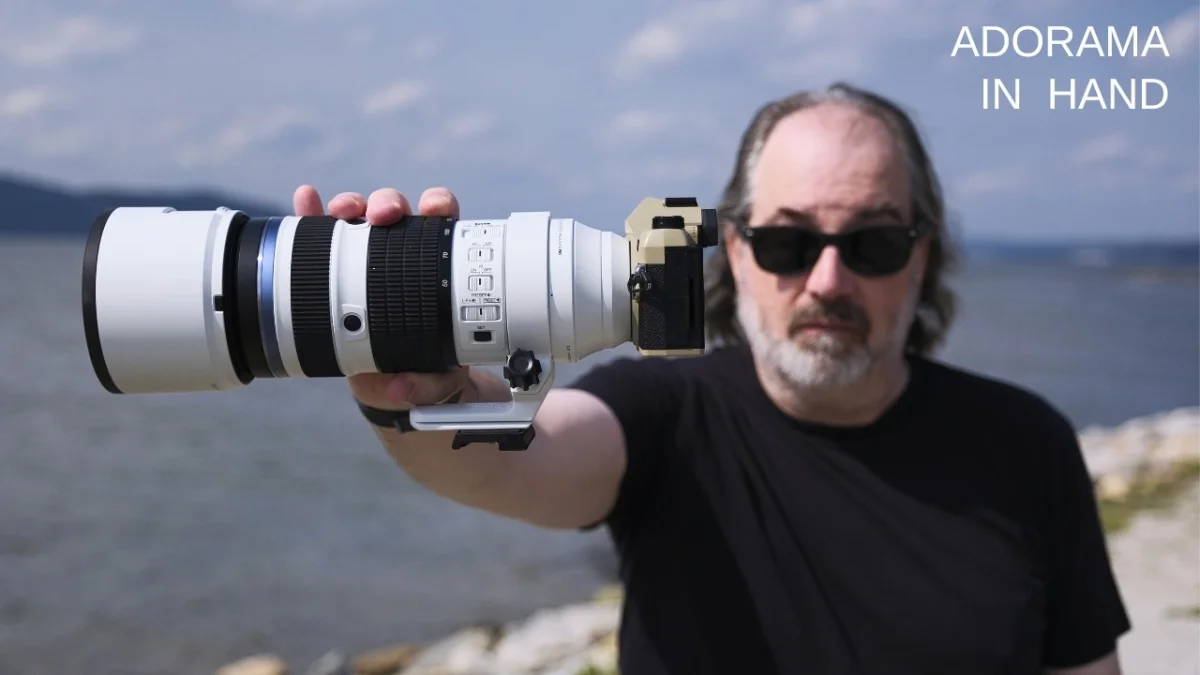
Portability is where the system pulls furthest ahead. OM has pushed hard toward bird photography, outdoor work and travel, and the weight savings from lighter bodies and smaller lenses are a big part of that. The M.Zuiko Digital ED 50-200mm F2.8 PRO, which gives a 100-400mm equivalent reach, is only 8.9 inches long and weighs under 3 pounds. That compact length matters as much as the weight when you're scrambling over uneven ground. A smaller backpack works, and a camera carried across the chest doesn't swing a long lens into your ribs on every step.
Live ND: The computational ND is the feature I'd flag as both a strength and a limitation. Because it's computed rather than physical, expect temporary preview blur while you adjust composition. It clears up once you refocus. Shutter speed alone won't rescue a shot taken from a moving vehicle. Graduated ND shots taken from a car window showed blurry foregrounds even at very high shutter speeds. Use a tripod or stop the vehicle.
Live composite: This is the sibling of live ND, and it builds up light changes over time. It's useful for capturing fireflies without stacking dozens of frames later, and it suits fireworks, light painting and star trails.

In-camera focus stacking: Anything that cuts editing time is welcome, and this is a strong option for macro work. Lens compatibility is the catch. Not every lens supports the feature, so check before buying glass if you plan to rely on it.
Where Each OM Body Fits
The Micro Four Thirds lineup covers a wide range of budgets and shooting styles.
OM-D E-M10 Mark IV
Aimed at new and hobbyist photographers, content creators and budget-minded travelers. It keeps IBIS, which is rare at this level, and includes Advanced Photo (AP) mode, Art filters (ART) and Scene (SCN) presets to ease the learning curve. A forward-flip selfie screen with SELFIE mode suits people moving up from a phone.
OM-5 Mark II
Built for adventure, street, wildlife and everyday shooting. It offers a 2.36M-dot OLED viewfinder, IP53 weatherproofing and a dedicated Starry Sky Autofocus mode, along with computational modes such as live ND and focus stacking.
OM-3
A lightweight body with vintage-inspired styling and tactile controls. It carries the OM-5 Mark II's OLED and weatherproofing and adds 4K 60p video, cinematic video profiles and S&Q mode. An easy-access creative dial gives quick access to color preferences and art filters without breaking your shooting flow.
OM-1 Mark II
The flagship, aimed at pro and enthusiast shooters across wildlife, sports, portraits, weddings and video. It uses a stacked BSI Live MOS sensor with the TruePic X processor and offers 8.5 stops of IBIS, which reduces tripod dependence. Pro Capture buffers up to 99 frames at up to 120 fps before you fully press the shutter, so you won't miss the moment that starts just before the press.
OM-3 ASTRO
This one has a modified IR-cut filter that captures the deep reds of the night sky more faithfully. Live composite, Starry Sky AF, night-tuned color profiles and a night vision live view mode are all aimed at astrophotographers and night-scene shooters.
Is OM Worth a Spot in Your Bag?

Leaving Canon, Nikon and Sony for a smaller system takes some nerve. My read is that the results make the choice easier than it sounds. If weight, bulk and travel comfort are shaping how often you actually go out, OM gives you real image quality and a kit that's easy to carry all day. The learning curve is in the settings, not the sensor, so budget some setup time before your first trip.
Daniel Norton has tested OM SYSTEM's largest PRO lens, and his video shows how it handles in hand and in the field.