First day cover ·
Shooting Doorways in Kolmanskop: Wide Lenses, Flat Light and Honest Edits
Muji's Kolmanskop shoot shows how a wide lens bends doorframes, why overcast skies flatten sand, and where AI editing starts to bend the truth.
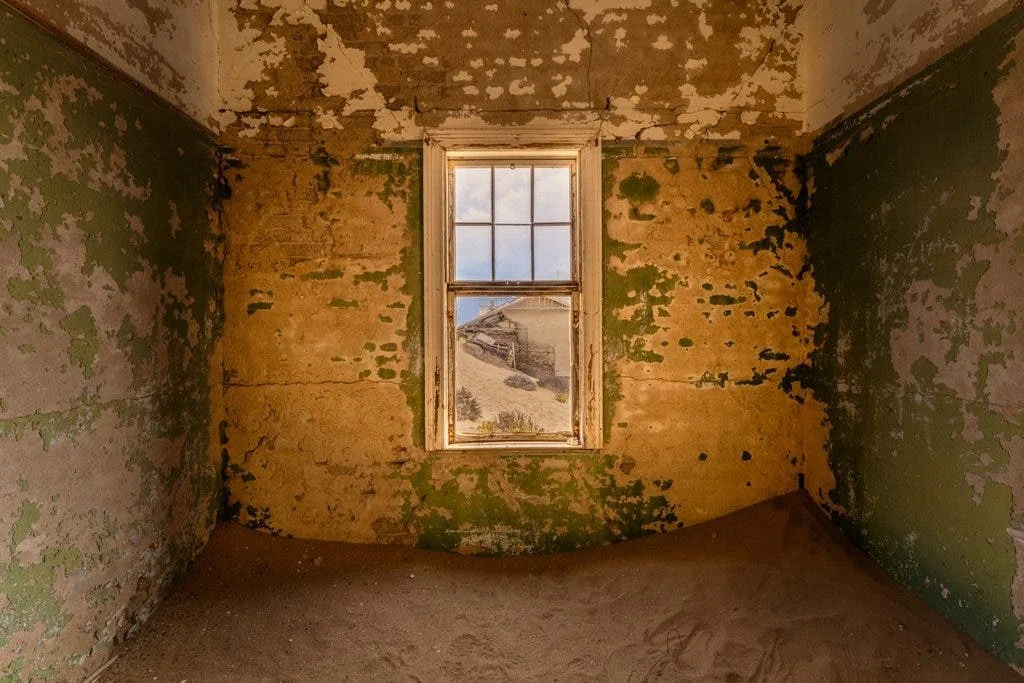
Kolmanskop started in 1908, when a worker near the railway tracks in Lüderitz, Namibia, spotted a diamond in the sand. German colonial authorities saw how easily the stones could be collected and built a quarry and a town around it. The wealth lasted a few decades. When the diamonds ran out, residents left almost as fast as they'd arrived, and the Namib desert has been reclaiming the buildings ever since.
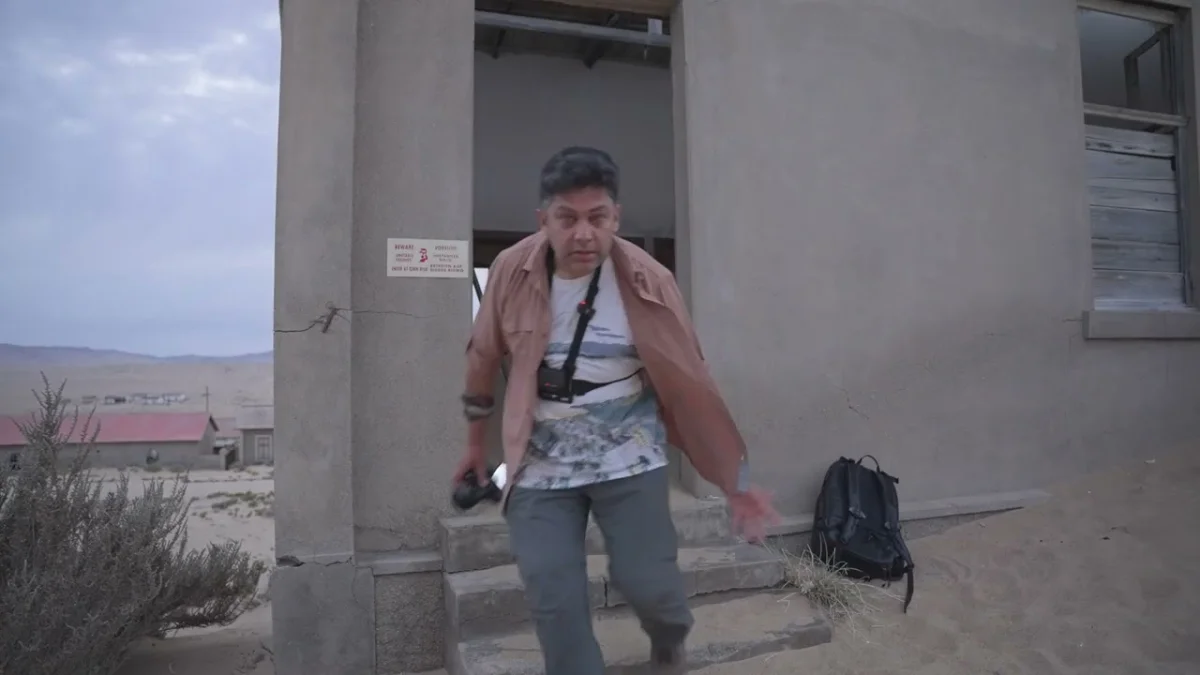
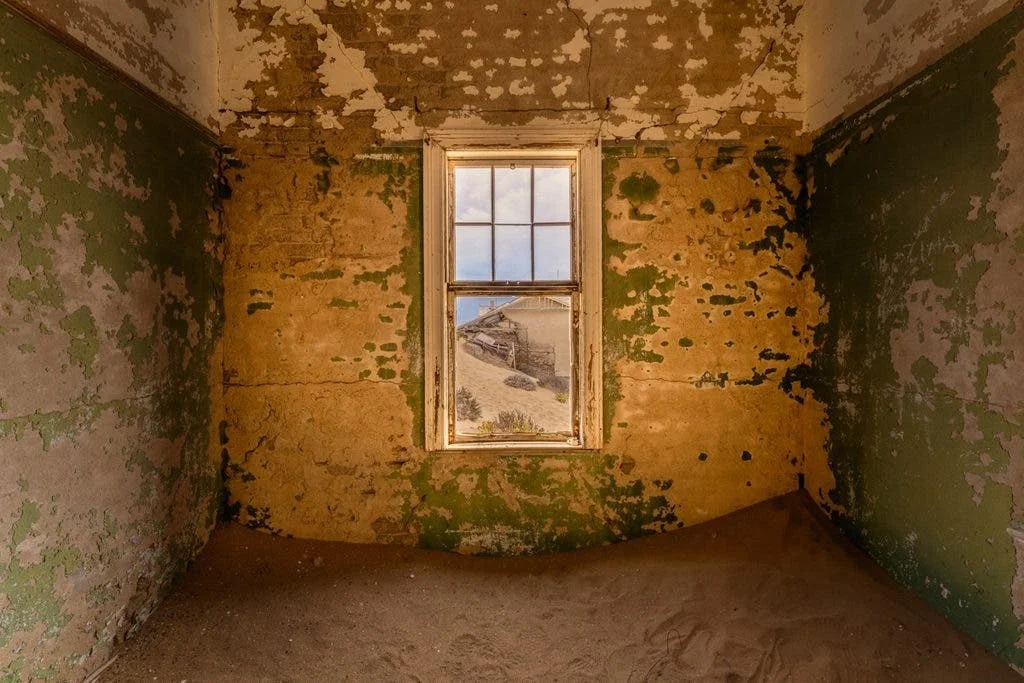
For photographers, that reclamation is the appeal. Drifts of sand pile against window sills and door frames, and the rooms still hold the peeling paint and cracked plaster of a town that stopped. Muji drove 600 miles from Cape Town to shoot there, and the trip exposed three problems that anyone working in confined ruins will recognize: lens distortion, unreliable light and the temptation to fix too much in post.
Wide Angles in Tight Rooms
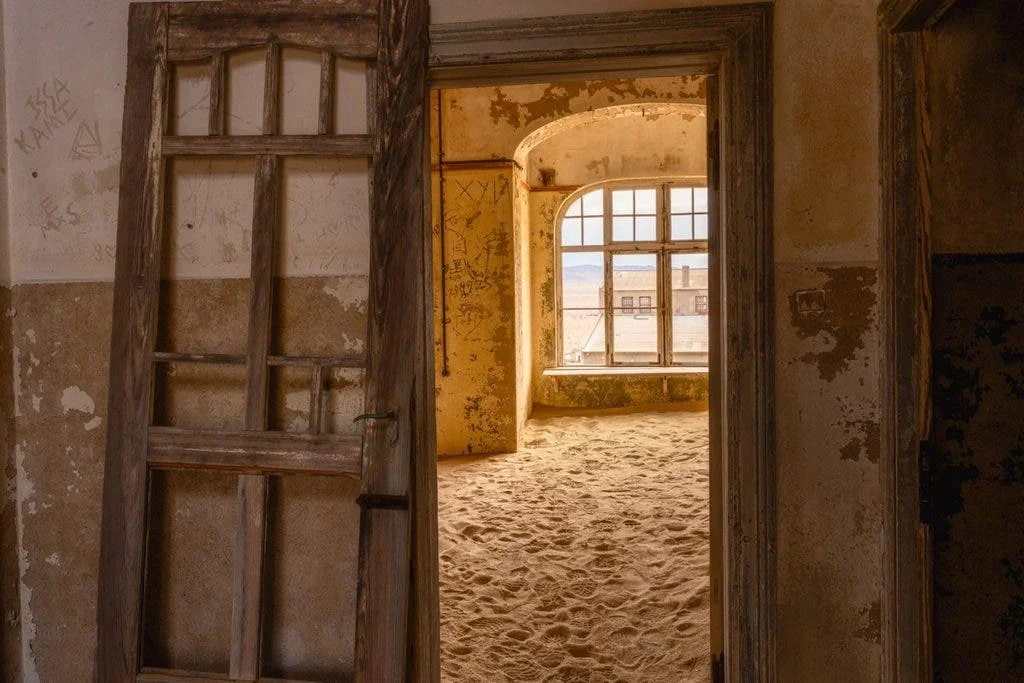
The rooms at Kolmanskop are small, which leaves little choice. Muji worked mostly with a Tamron 17-28mm f/2.8 Di III RXD, and at those focal lengths the door frames look skewed even though they're level. The distortion is strongest where a straight line runs toward the edge of the frame, and it can make a doorway seem to lean into the room.
The workaround is to face the opening head-on. Shooting straight into a frame keeps the verticals parallel and the wooden beams honest. The catch is that a head-on angle isn't always the strongest composition. Shooting from the side means constantly tilting the lens up or down and adjusting focal length to keep edges natural, while still showing how big the room is. That balancing act is most of the work here.
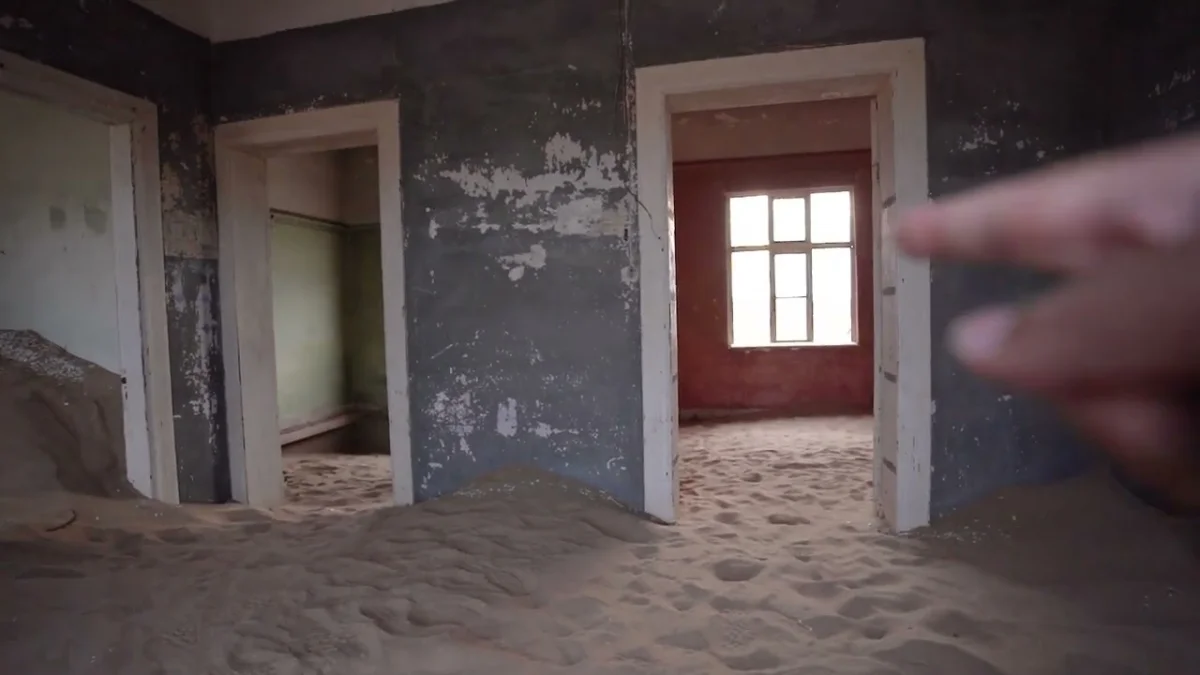
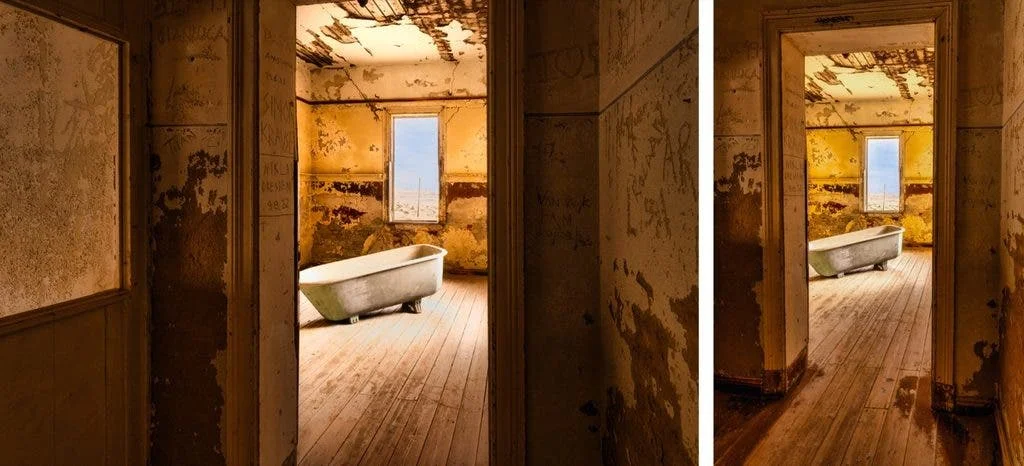
A practical demonstration of how a wide-angle lens warps straight lines.
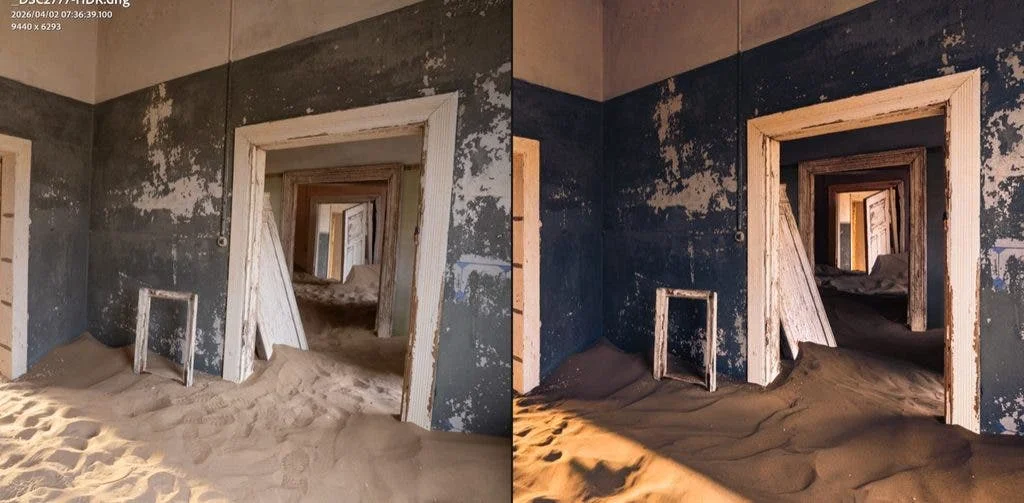
When location choices run out, correction happens in the edit. Muji used the Transform tool in Lightroom to straighten the frames. The cost is pixels: every correction crops away edge detail, so it's worth framing generously on location. The before-and-after below shows how much a door that's actually level can look warped under a wide lens.
Waiting for Light
Sunrise is the time to shoot here, with low, slanting rays working their way through the openings. Muji followed a tip from another photographer and set up in a room with promising sunrise angles, camera ready. Then the clouds stayed put. Without directional light, even strong rooms went flat, with little contrast between light and shadow and sand textures that lost their definition.
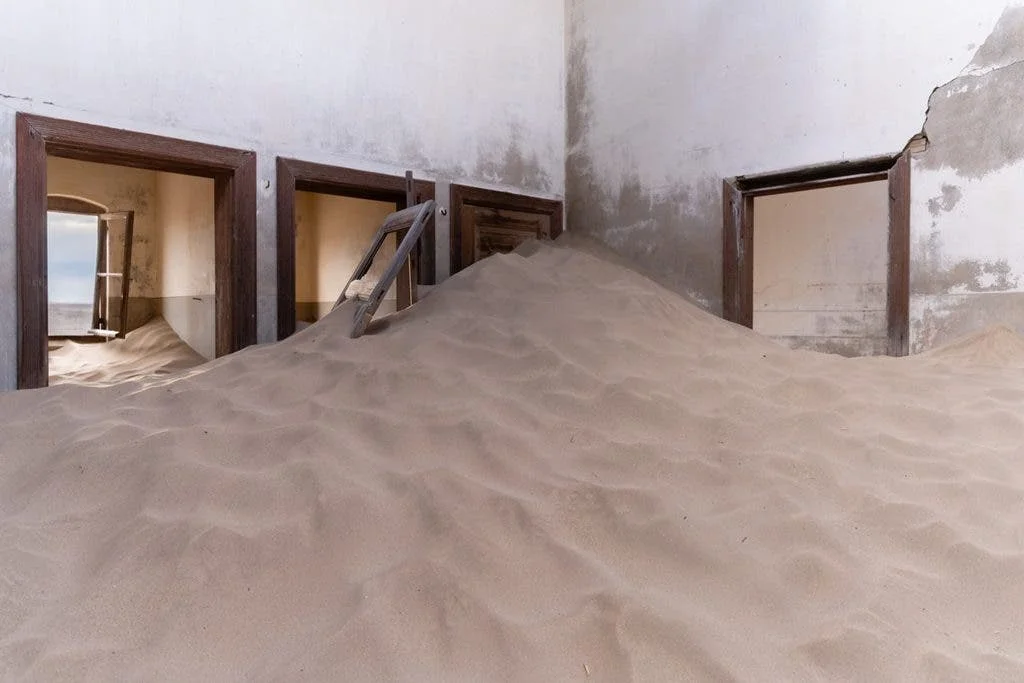
After about an hour, a gap opened for roughly 30 minutes. That window produced steeper, more vertical light falling onto a sand bank, and it's the reason a few frames work. The practical lesson is to stay in the room. Light at these sites arrives on its own schedule, and the photographers who wait for it tend to get the frame.
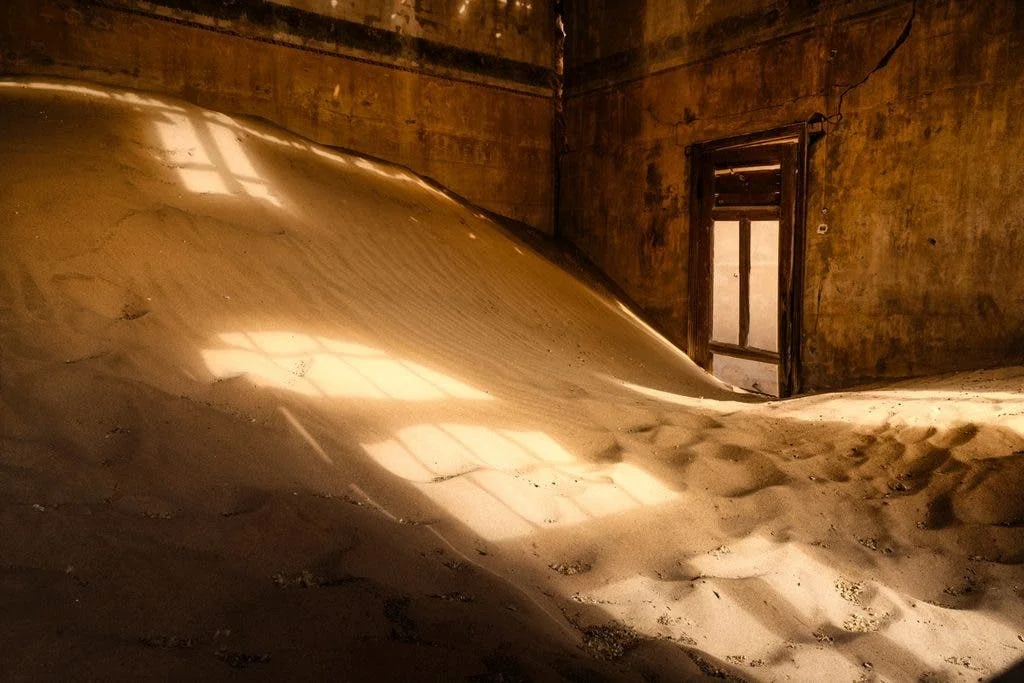
When direct sun never shows up, some of the effect can be built in post. Muji added simulated light filtering through in a few frames, and the result is an interpretation of the room, not a record of it. That's a choice worth making deliberately rather than by accident.
Composition Under Pressure
Muji's on-location decisions favored simplicity. Horizontal framing gave more room for the surrounding story and environment, though vertical framing remained a personal call. A freestanding bathtub in a sunlit room, with peeling walls and graffiti, shows how orientation changes what the viewer reads first.
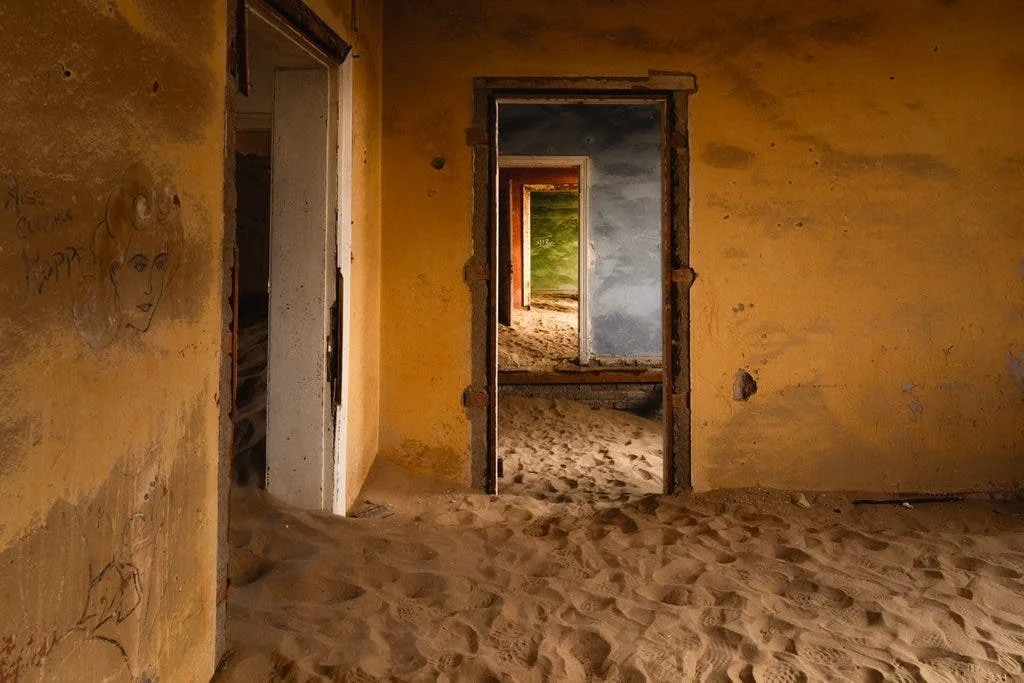
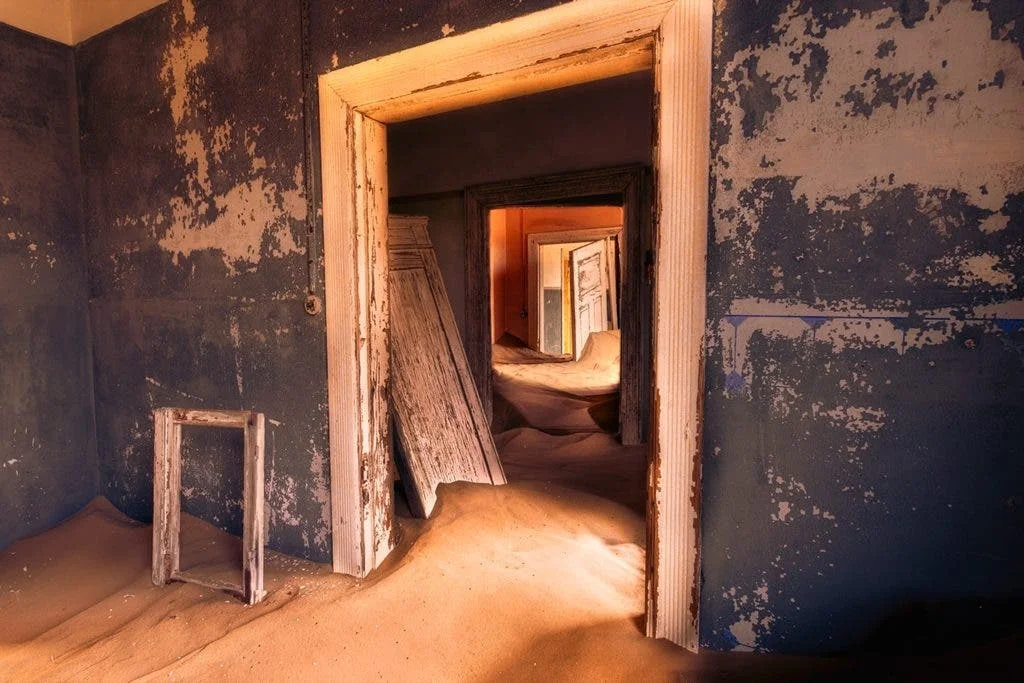
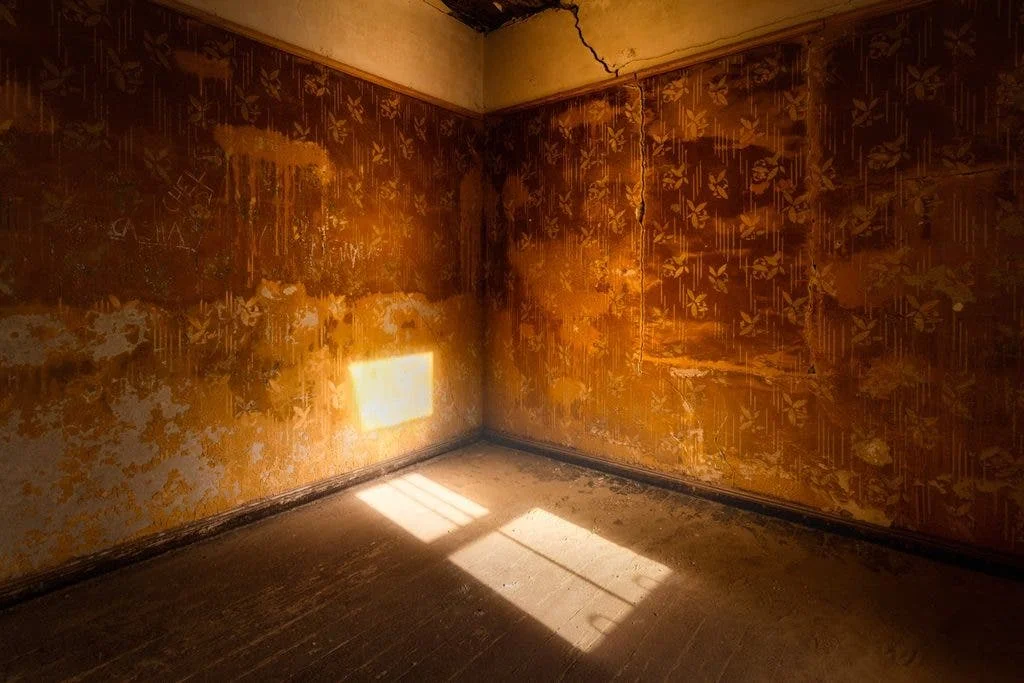
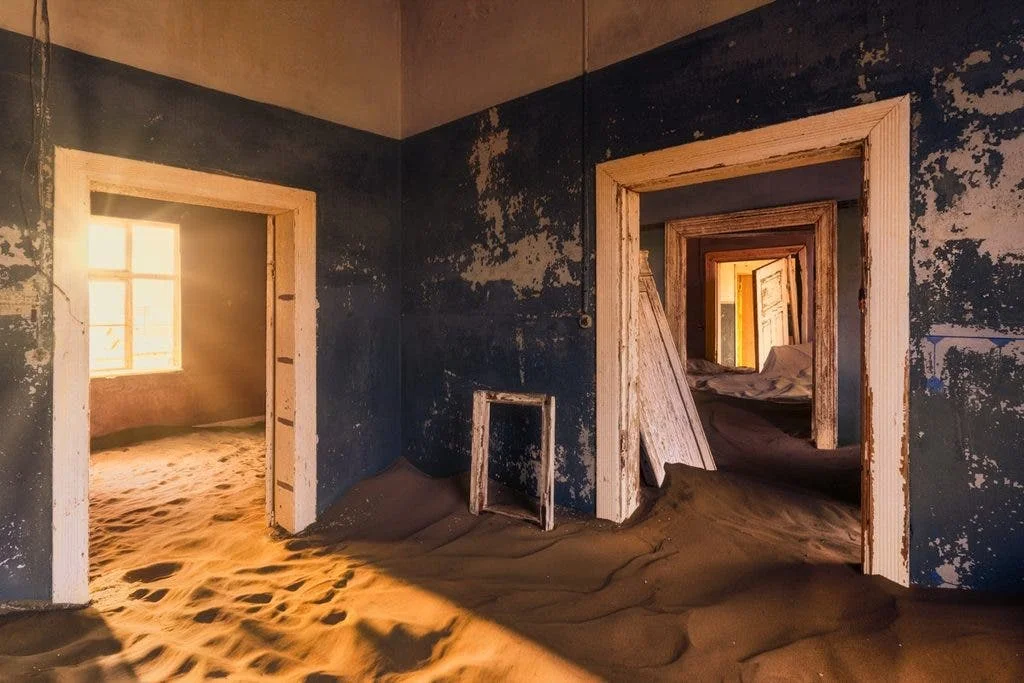
A series of doorways, each opening onto the next, gave the shoot its "Inception" frame. The repetition does the work: one door leads to another, and the sequence starts to feel like a dream within a dream. Muji's strongest compositions were the simplest, though. A single patch of window light on a dusty floor carries more mood than a busy room, because it lets the viewer see the deep scars and subtle textures in the wood.
Where the Edit Crosses a Line
Muji's usual workflow is restrained. In Lightroom, AI is limited to noise reduction, dust spots and small litter, with no sky replacements and no added elements. Luminar handles retouching and quick people edits, where its AI tools save real time. This shoot broke those rules on purpose.
Footprints were the main problem. Sand holds every step, and unless wind has cleared the dunes the day before, they're hard to avoid. Muji removed them from some frames and left them in others, which is a useful reminder that the decision can vary image by image.
Luminar did the heavier lifting on the enhancements:
- A Sunstar added to a few images for drama.
- Light Depth used to brighten windows and frames where light naturally fell, creating focus.
- Glow and Orton effects for soft focus, offsetting the flat light.
- Layered Fog from the Atmosphere feature to push the ghostly mood.
There's a real case on both sides. AI-driven tools can turn a dull frame into the image you pictured, and that's a legitimate form of expression. They also push the work further from documentation. Muji's position is transparency: if these images were sold, every removed footprint and every added sunbeam would be disclosed. That's a standard worth borrowing, whether or not you're shooting ruins.
Slowing Down in the Sand
The shoot could look like a scramble against the clock, but Muji treated it as deliberate work. A Leofoto LS-324CXPRO carbon fiber tripod with an LH-40LR ball head kept horizons level and frames sharp in dim rooms. Sharp, level frames matter more when the post-processing choices are this heavy, because they give you a clean baseline to deviate from.
The results reflect a mood more than a literal record of the day. Some frames aren't an exact account of how the scene looked that morning, but they're an honest account of how the place felt. Kolmanskop rewards that approach, and it's a useful test for any ruin shoot: decide early which parts of the image are documentation and which are interpretation, then keep that line visible in the final edit.