First day cover ·
Xinkhova Female’s Possible New Den: Following Fresh Leopard Tracks
A two-hour trail led to boulder crevices once used by another leopard. The Xinkhova Female’s cubs weren’t there, but the site may offer a quieter den.
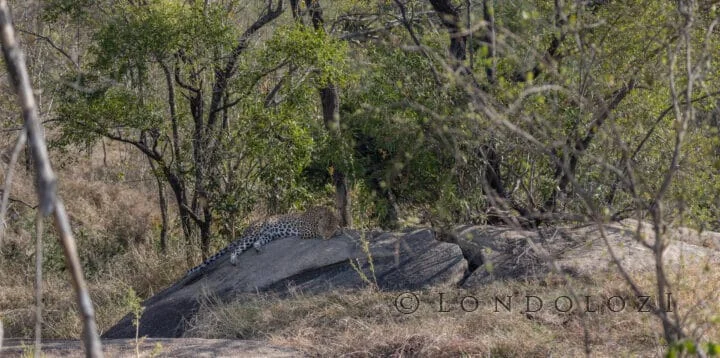
The Xinkhova Female’s cubs weren’t at the boulder den we hoped to find, but her careful inspection of the rocks raised another possibility: this quiet drainage could become a place to move them. The site has crevices for cover, elevated rocks to watch from and distance from the camps and river frontage.

That idea emerged after two days of searching for the five-year-old leopard, born in 2021 and the daughter of Nkoveni. Her tracks had led into dense cover beside a waterhole, while an impala kill was found hoisted nearby. The searchers couldn’t locate her, and the carcass remained untouched.
Later, the landcare team saw her carrying a cub into the river near Tree Camp. On an afternoon search, they found tracks going in and out of the area but couldn’t reach the stretch of river where she had vanished. The untouched kill suggested she had made it, then left it behind to move and nurse her cubs. With no further sign, the plan was to try once more the following morning.

Following the trail through the drainage
Fresh tracks along the river gave the team a starting point. Male tracks crossed the area too, suggesting the two leopards had briefly overlapped overnight before separating. Trackers Lucky Shabangu and Geshom continued on foot, listening for alarm calls; ranger Matt Dawson and the narrator drove around to reconnect with them.
Squirrels called from the trees, and a waterbuck sounded an alarm as the female moved ahead. The calls didn’t reveal her exact position, but they helped confirm that something had stirred the animals along her route. The team was close behind.

Fresh tracks at first light put the team on the trail and made the possibility of finding the leopard feel close.
The tracks climbed toward the Mashaba drainage line, a steep, riverine channel that feeds into the Sand River. At the top of the hill, they looked fresher still. The trail followed a game path toward a waterhole, with the impala remains farther upstream. The team had wondered whether the female might return to the kill, but the tracks showed she hadn’t yet gone that far.
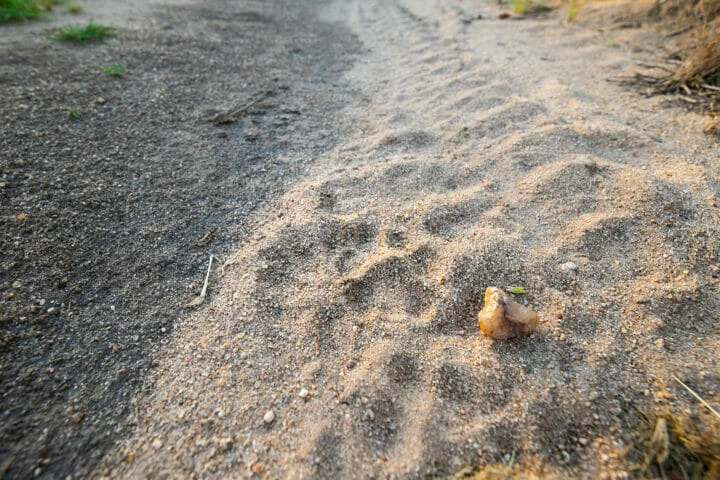
Dawson looped around. A radio call followed: he had found her walking along the road toward the waterhole.

The harsh light shows how late in the day the team finally caught up with her.
By then, the search had lasted about two hours. The female moved steadily into thick vegetation, pausing to listen. Game paths behind the waterhole let the vehicles keep pace as she continued up the drainage. She was no longer heading toward the kill. Instead, she stopped for a long time, tail twitching as she watched and listened.

A squirrel above the vehicle had spotted the female and drawn her attention.
A familiar set of rocks
The boulders ahead carried a memory for the narrator. In July 2022, ranger Kyle Gordon and the narrator had tracked the Plaque Rock Female to this area after wild dogs took her kill. The narrator was a new guide and hadn’t expected a glimpse of a cub. The female emerged from the dense cover with her young one, carried it to a more open spot, groomed it and let it nurse, then leapt from a boulder with the cub still held in her mouth.

The Plaque Rock Female’s cub was hidden in the rocks until she brought it into view.

She carried the cub to an open area to groom it and let it nurse.

The female jumped from the boulder while holding the young cub in her mouth.
Four years later, the Xinkhova Female approached the same rocks with caution. The team kept its distance as she dropped into the drainage between the boulders and disappeared. When she reappeared, she carried nothing. She sniffed around, explored another crevice and eventually rested on the rocks.
Her nursing status was still visible: brown patches on her belly indicated that she was continuing to nurse her cubs. But they weren’t in the boulders that day.

She rested in the shade after investigating the rocks; brown patches on her belly showed she was still nursing.
A possible refuge for the litter
The search didn’t confirm a new den, but the location has features that could suit one. It sits away from the camps and the river, within a drainage line where rock crevices offer places to conceal cubs and boulders provide vantage points. The Plaque Rock Female had used the area to den before. After recent activity along the river frontage, the quieter setting may appeal to the Xinkhova Female as a place to raise her litter.
Only one cub has been seen being carried, so the litter’s size remains unknown. The team won’t search the river den; instead, it will quietly watch the boulders in the days ahead. If the female moves her cubs there, this familiar patch of rock may become her next den.