First day cover ·
Tokina’s APS-C f/2.8 Zoom Trio Covers 11mm to 135mm on a Budget
Three used Tokina zooms span ultra-wide to telephoto, with constant f/2.8 apertures and prices that can make a complete Canon APS-C kit attainable.

Three constant f/2.8 zooms can cover a Canon APS-C camera from ultra-wide views to telephoto framing. Tokina’s 11-20mm, 16-50mm and 50-135mm lenses form a practical kit with used prices listed at roughly $100 to $250 per lens. For photographers willing to use older autofocus designs, the appeal is straightforward: broad focal-length coverage, a bright maximum aperture throughout each zoom, and a lower cost than buying a single premium lens.
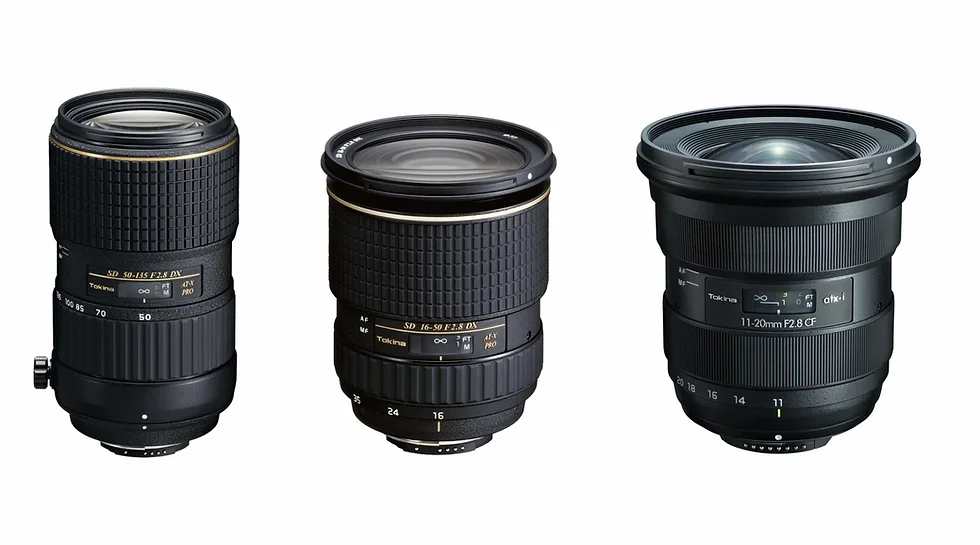
On Canon APS-C bodies, the three zooms provide fields of view roughly equivalent to 17.6-32mm, 25.6-80mm and 80-216mm on full frame. Together, they cover 11mm to 135mm in actual focal length, with no gap in the ranges. The lens choices divide naturally by task: the 11-20mm handles wide scenes, the 16-50mm works as an everyday zoom, and the 50-135mm brings distant subjects closer.
11-20mm f/2.8 CF: space for wide compositions
The 11-20mm is the most distinctive lens in the set. Its wide angle of view suits interiors, landscapes and expansive scenes for video, while its constant f/2.8 aperture keeps the maximum aperture consistent as you zoom. That can be useful when available light is limited or when changing focal length during video and avoiding an aperture shift matters to the shot.
At the wide end, careful placement of the camera matters: nearby objects can become visually prominent, and converging lines can shape the composition. That perspective can help give an interior depth or make a foreground element carry more weight, but it also rewards deliberate framing. The reported experience with this lens highlights strong center sharpness, contrast and color, along with a solid-feeling build. Its listed used price is about $150-$250.
16-50mm f/2.8: the general-purpose range

The 16-50mm is the natural choice when one lens needs to cover a varied day of shooting. Its full-frame-equivalent view runs from about 25.6mm to 80mm on Canon APS-C, spanning moderately wide scenes through short telephoto framing. That range can handle travel, events, portraits and everyday subjects without frequent lens changes.
Its constant f/2.8 maximum aperture is useful when light levels change or when a photographer wants a consistent exposure setting across the zoom range. At the longer end, the framing also gives more room to isolate a subject from the background than a wide-angle view does. The lens is listed at about $100-$200 used, making it the least expensive entry point into the trio. As with any older used zoom, condition and the particular copy matter when assessing an individual listing.
50-135mm f/2.8: telephoto reach for portraits and events
The 50-135mm gives Canon APS-C users a field of view comparable to roughly 80-216mm on full frame. That makes it the long-range member of the system, suited to portraits, sports, events and compressed landscape compositions. The constant f/2.8 aperture pairs reach with a bright maximum aperture, which can help keep shutter speeds up in dimmer conditions and separate a subject from its surroundings.
Its focal range is often likened to a professional 70-200mm zoom used on a full-frame camera, though the actual focal length remains 50-135mm. The distinction matters when comparing framing across formats. At about $150-$250 used, it offers a relatively affordable route to telephoto coverage. The lens receives less attention than the other members of the set, and detailed reviews or sample material can be harder to find. Reports from users cited here praise its sharpness and construction, but those impressions aren’t a substitute for checking the lens in person when possible.
What to weigh before building the set
Used prices listed for the trio range from $100 to $250 per lens: $150-$250 for the 11-20mm, $100-$200 for the 16-50mm, and $150-$250 for the 50-135mm. Actual asking prices and condition can vary. The key trade-off is age. These lenses don’t offer the more recent autofocus systems and features found in current mirrorless designs, so photographers should consider whether their camera body and shooting needs suit an older lens system.
The reported experience with the 11-20mm includes regular use for stills and video, with its wide view, constant aperture and optical qualities making it a favored choice. Across the trio, the combination of focal coverage and f/2.8 maximum apertures is the central draw. The 16-50mm handles many everyday situations, while the two zooms at either end extend the kit for broad scenes and distant subjects.
The three lenses were described as costing about the same together as a Sigma 50-100mm f/1.8. That comparison illustrates the kit’s breadth: the Tokinas span ultra-wide to telephoto, while the Sigma covers a shorter focal range with a wider maximum aperture. The right choice depends on whether a photographer values a wider range of framing or a faster lens over a more limited range.
For Canon APS-C photographers assembling a budget-conscious kit, Tokina’s trio remains worth considering when a used copy fits the camera and the work. Check each lens’s condition and autofocus operation, then match its range to the pictures you make most often. The result can be a three-lens system that moves from sweeping interiors to tight portraits without giving up a constant f/2.8 maximum aperture.